Annegret Kramp-Karrenbauer and Angela Merkel in Berlin, Feb. 10.
Photo: hannibal hanschke/Reuters
German politics was thrown into new turmoil Monday when Annegret Kramp-Karrenbauer, leader of the center-right Christian Democratic Union, announced she won’t run for Chancellor next year. The defense minister, known as AKK, was Chancellor Angela Merkel’s preferred successor.
The final straw for Ms. Kramp-Karrenbauer and her critics was a conflict with the CDU’s local branch in Thuringia in the former East Germany. State elections there in October were inconclusive, as has become the norm in Germany. The CDU and center-left Social Democratic Party (SPD) hemorrhaged votes while the neo-communist Left and far-right Alternative for Germany (AfD) surged. After months of negotiations, local CDU leaders agreed to cooperate with the AfD and the free-market Free Democratic Party to form a state government—defying Mrs. Merkel and Ms. Kramp-Karrenbauer’s blanket ban on CDU alliances with the AfD.
Yet Ms. Kramp-Karrenbauer—called “mini Merkel” for her close relationship with Germany’s long-time leader—never enjoyed full control of the party. Her selection as leader in late 2018 represented an attempt to suppress debate within the party by rejecting the free-market convictions of Friedrich Merz or the more assertive tone on cultural issues from Jens Spahn, both of whom challenged AKK.
That debate hasn’t disappeared, and now voters also are confused about what the CDU stands for or whether the party can respond to their concerns. In addition to Thuringia, state elections in Saxony and Brandenburg have been disasters for the CDU on Ms. Kramp-Karrenbauer’s watch.
AKK’s critics within her party fret that this is clearing an electoral path for the AfD, which combines scattershot economic populism with nationalism that many Germans find troubling in light of the country’s history. Those worries are probably overblown since AfD still struggles to expand its support outside the states of the former East Germany. But a different electoral threat to the CDU is emerging from the center-left Greens, who appeal to a desire for a mainstream alternative to Mrs. Merkel’s suffocating centrism.
Voters everywhere want politicians who stand for something other than anything or nothing. As Mrs. Merkel’s long tenure winds down, German voters appear to be tiring of her woolly consensus politics and the grand left-right coalitions with the SPD by which she has governed for most of her time in power. Her party missed its chance in 2018 to give voters an alternative. Now it has another.
After 27 years of campaigning for Britain to leave the EU, Brexit Party leader and former U.K. Independence Party leader Nigel Farage gave his final speech to the European Parliament on Jan. 29, 2020. Image: Michael Kappeler/DPA via ZUMA Press
Everyone’s favorite beheaded BB-8 is live on tape. In a recent Twitter-storm of images, video, and product details, XDA Developer’s Max Weinbach shares a boatload of details on the Samsung Galaxy Home Mini — just two days before the speaker’s planned rollout on February 12. The Bixby-brained speaker that fits in the palm of your hand is Samsung’s long-awaited SmartThings-warrior designed for combat with the Echos and Google Homes of the Internet of Things (IoT) playscape.
Perusing the Galaxy Mini device features in the Samsung SmartThings app, what we’ve come to expect from our regular smart speakers is all here. The Galaxy Mini will read you the news, jam your favorite playlists, and send you notifications from connected smart devices, such as doorbells and Samsung washers. Music playback will be available in both stereo and multiroom modes, allowing you to link a bunch of Minis together for whole-home sound. According to Weinbach and sources, the speaker features Bluetooth linking for pairing with other smart speakers and, volume-wise, the Mini gets loud.
All cool news, but pretty standard fare. What really sets the little titan apart from the competition?
The infrared (IR) blasting, of course.
The Galaxy Mini speaks the age-old language of nearly all of our at-home electronics. With a few simple taps in the SmartThings app, users will be able to program their favorite TVs, soundbars, game systems, and streaming devices straight into the Mini, turning the speaker into an all-in-one remote-control command post.
With Bixby at the helm, you can simply walk into your living room and tell your Mini to turn on some Netflix. In just a few seconds, your TV and soundbar will be turned on and set to the correct inputs, with Netflix launched. The IR blasters have about a 40-f00t range, making it a match for the average living room or home theater cave.
The Mini does seem to have a couple of drawbacks, but it’s mostly minor stuff. For one, there are apparently no 5GHz capabilities. This isn’t make-it-or-break-it news, since many in-home IoT devices launch without that second antenna, but it would have been nice to have the option to choose which Wi-Fi band the Mini would live on. On the hardware end of things, there’s also no line-out jack. Again, not a huge deal, especially with the speaker’s various Bluetooth options for music, but a plug-and-play option never hurts. This being the first-gen run for the Mini, we can easily see both the 5GHz-band and line-out jack being integrated into future models.
Now that we’ve covered the future, what about the past? The Galaxy Home Mini is sure to be a big win for Samsung fans, but whatever happened to the Galaxy Home standard edition? Recent news would suggest that Samsung is still perfecting the Mini’s big brother and, as of now, there’s no release date in sight. While it’s a bit of an oddball move on Samsung’s part to launch the little guy first, at least users are able to get a taste of Samsung’s IoT chops before their bigger smart speaker hits the shelves.
Upon first glance, the Nest Mini looks a lot like the Google Home Mini. That’s because it’s the second generation of Google’s smallest smart speaker. But, despite their exterior similarities, there are a lot of differences between the two. The Nest Mini offers improved sound quality, faster response times from Google Assistant, and it’s made from sustainable materials.
What is the Nest Mini?
Credit: Google
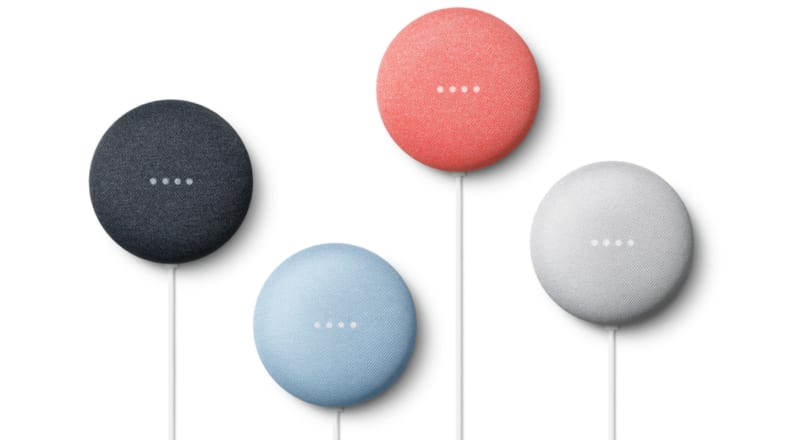
The Nest Mini is also sold in four colors: Chalk, Charcoal, Coral, and Sky.
Released in October 2019, the Nest Mini is Google's latest compact smart speaker featuring Google Assistant. It includes a power adapter, so you can plug it into a nearby electrical outlet to get the speaker up and running. To set up the device, you'll need a steady WiFi connection, a Google account, and the Google Home app on your iOS or Android device. The set up process for the Nest Mini is simple and can be completed in just minutes.
How well does the Nest Mini work?
One notable upgrade for the Nest Mini is the improved functionality and faster integration of Google Assistant. With three far-field microphones built into the Nest Mini, it has no problem hearing you (correctly, for that matter) from the other room. But, keep in mind that where you put the speaker can have an impact on the sound. I left mine sitting on the kitchen counter and there were no issues.
The Nest Mini also touts a faster Google Assistant, taking less time to complete common commands.
It’s worth mentioning that Google designed the speaker to work best when placed no more than a foot from a wall. There’s also the option to mount the Nest Mini on the wall using the bracket on the backside of the device—just make sure there’s an electrical outlet nearby to plug into.
The Nest Mini also touts a faster Google Assistant, taking less time to complete common commands, like turning my office lamp (which I have on a smart plug) on and off, and adjusting the temperature of my smart thermostat. To speed things up a bit, Google placed a machine learning chip inside of the Nest Mini to help the smart assistant learn the commands you use most frequently and process them more quickly.
Whether it’s a smart display like the Google Nest Hub Max or the Google Home Mini, I’ve always been impressed by how well Google carries a conversation. Sometimes our smart assistants don’t always hear us the first time around, or they might misunderstand and get the command wrong, but the Nest Mini excels at getting it right the first time.
Nest Mini sound quality is impressive
Right away, one of the first things I noticed while getting to know the Nest Mini was the impressive sound quality. It’s clear and rich, but that’s probably because it has 360-degree sound with a 40 mm driver and two times the bass of the Google Home Mini.
Unlike the Google Home Mini, the Nest Mini will automatically adjust the volume of the speaker’s response when there’s too much noise in the background.
However, the Nest Mini is lacking a 3.5 mm audio output port, which would allow you to connect the smart device to larger speakers. It’s not a make-or-break feature for me, but one that would be nice to have since Amazon's rival smart speaker, the Echo Dot (third-generation), includes an audio jack. That said, if you have multiple Google Home speakers, you can sync them together in the Google Home app to play music podcasts throughout your house.
Unlike the Google Home Mini, the Nest Mini will automatically adjust the volume of the speaker’s response when there’s too much noise in the background. So, if you have your speaker’s volume set low, around volume level 2 or 3, and you ask Google Assistant a question or tell it a command, it will respond back at a higher volume level to accommodate for the noise level in the room. (This feature is a godsend if you have loud children like I do.)
Additionally, the volume can be adjusted up by tapping on either side of the top portion of the Nest Mini. The sound can be tuned higher by tapping the middle right side of the speaker and lowered by tapping on the middle left side.
Tired of listening to the same ol' Google Assistant voice? Well, the Nest Mini includes 12 different voice options for Google Assistant. To change the sound of Google Assistant on your Nest Mini, open the Google Home app, tap your account in the upper righthand corner, and make sure you have the right Google account linked. Then, go back to the home screen of the Google Home app. Navigate to Settings > Google Assistant services > More Settings > Assistant > Assistant Voice. There, you can choose from one of 12 voices, including celebrity voices like Issa Rae and John Legend.
What does the Nest Mini look like?
Credit: Google
There's a wall mount bracket on the back of the Nest Mini so you can easily hang it up.
One of the coolest things about the Nest Mini is that it's sustainably made. The fabric on the top portion of the speaker is made from 100% recycled plastic bottles and the bottom is made with at least 35% post-consumer recycled plastic. But, materials aside, the Nest Mini is basically a clone of the Google Home Mini in terms of looks.
And, like the Google Home Mini, the Nest Mini is also sold in the same four colors: Chalk, Charcoal, Coral, and Sky. It’s a little bit of a letdown that there aren’t any new color options.
Privacy concerns with the Nest Mini
With stories of hackers gaining entry into smart home security cameras, privacy concerns are at the forefront of many consumer minds these days, and rightfully so. And, if you have a smart home speaker in your home already, you may already be mindful of how your information is shared and your ability to control privacy settings on a particular device.
Major tech companies like Apple and Amazon have addressed privacy concerns overusing audio recordings as part of their respective voice-assistant quality evaluation processes—and Google did the same in September 2019.
Google published a blog about how the company is working toward protecting user privacy as it relates to Google Assistant. But, the company underlined that they do not "retain your audio recordings" and have never done so.
So, what does it mean for you? As far as the Nest Mini is concerned, Google won’t automatically store your conversations with Google Assistant unless you give the Nest Mini permission to do so. You can opt into Voice and Audio Activity when setting up your Nest Mini.
On the bottom portion of the device, you’ll find a toggle switch that turns the mic on and off. So if you’re concerned about a sensitive conversation being recorded, just manually power off the microphone.
Should you buy the Nest Mini?
Credit: Google
The Nest Mini is small enough to place anywhere, making it a great choice for apartment dwellers.
If you’re on the hunt for a Google Assistant-enabled smart speaker that offers clear audio, high quality sound, and fast response times, then the Nest Mini is worth the $49 upgrade. Additionally, if you’re short on space, then the Nest Mini is a no-brainer addition to your smart home, since all you need is a drywall screw to hang it up, freeing your credenza or kitchen counter of the compact smart speaker.
The Nest Mini has been known to go on sale every now and then. So, if you’re holding out for an even lower price, keep an eye out during major holiday sales. But, for under $50, the Nest Mini makes a helpful and affordable addition to any budding smart home.
The product experts at Reviewed have all your shopping needs covered. Follow Reviewed on Facebook, Twitter, and Instagram for the latest deals, product reviews, and more.
Prices were accurate at the time this article was published but may change over time.
“A 2015 Mini Cooper. Engine bay might be a bit tight, but there’s no rust, so this job will be easy!” I told my naive self before agreeing to fix my friend’s engine mount. His dealer had quoted him a huge figure for the job and I couldn’t stand by and watch him part with all that cash, not when we could easily do it ourselves for cheap! But oh how wrong I was. The Mini now sits stranded in a garage in Washington D.C. because I screwed up royally.
Ever since the high-stakes Holy Grail Jeep Grand Cherokee trip I made back in December, I’ve been taking a break from wrenching and working on some personal goals (namely discovering cool cars in southeast Asia). But when my good friend Jeb asked for advice about a quote he got from his dealership, I dusted off the old wrench, and headed to D.C. where I had to go anyway to track down a separate story.
Advertisement
On the menu for the Mini was a new cabin air filter, replacement spark plugs, freshly-squeezed-from-the-bottle motor oil, clean brake fluid, and—the big one—a non-leaky engine mount.
I’d done a bit of googling, and learned that swapping the motor mount looked fairly trivial—we just had to remove one of the headlights, unbolt some trim, support the motor, and wiggle the old mount out, so I wasn’t even slightly worried. Which is why when yesterday ended like this, I was a bit bummed:
At first, everything seemed to be going swimmingly. None of the car had any corrosion, so every bolt came out with ease, and despite the compact front-wheel drive, transverse engine layout, accessing various under-hood components wasn’t horribly difficult.
Advertisement
Jeb and I were on the fast-track to having big checks in our W columns when disaster struck. No matter what we did, one of the two bolts holding the engine mount to the body would not thread properly. What’s worse is that we didn’t realize how bad it was until we’d cranked the thing into the body, removed the bolt, and glanced at the copious metal shavings on the threads.
Normally, I start my bolts by hand to prevent this sort of thing, but there was a piece of difficult-to-remove plastic trim pushing against the side of the bolt. Jeb and I thought this was the source of the resistance to rotation, but it turns out, it was the dreaded phenomenon known as the cross-thread. Now, every time we insert the bolt—and we’ve tried this 100 times—it binds up. And looking inside, it’s clear that we’ve really screwed those threads up pretty badly.
Advertisement
This is a big deal, because the engine mount—which literally holds the 2.0-liter turbocharged motor to the car—is held to the body of the vehicle by only two 12-millimeter bolts. If the fastener shown in the top right of the photo above isn’t doing its job, the motor will flop all over the place, so this bolt absolutely has hold the motor mount in place. It’s critical to the operation of the car.
Advertisement
After over six hours of wrenching, Jeb and I had to give up and leave the car in his in-laws’ garage overnight, where it now sits without one of its motor mounts, and with a floor jack supporting the engine from below. Since last night, I have been tossing and turning, agonizing about how I’m going to solve this issue.
Advertisement
There’s no way to get to the hole—which goes into the vehicle’s suspension strut tower—from the back side, which means if I wanted to insert the bolt or a thread chaser from the other direction to clean/align the threads or, worst case, install a nut and washer back there, I can’t.
What makes things more tricky is that there’s no room to drill the hole out and throw in a helicoil (a threaded insert that would provide new threads that are the same dimensions as the current ones, meaning I could use the factory bolt meant for that engine mount).
Advertisement
So really, I have only one hope of fixing the dastardly hole shown in the top left of the photo above: I have to use a thread restorer (essentially a tap), and pray that I can spin it into the hole, and fix what’s left of the threads to an extent that allows the bolted connection to reach the 74 lb-ft torque spec.
Advertisement
I have had success with a thread restorer kit before (I’ve also had terrible luck with one before, when I accidentally used one of the dies as a nut, and had to undo a bunch of work to get it back out—clearly, I make lots of mistakes while wrenching) and looking at the reviews of the one I plan to rent for free from AutoZone, I am relieved to know I’m not the only dumbass who leaning on this tool to solve a critical motor mount problem:
Advertisement
If this doesn’t work, I’m not really sure what I’m going to do. I can try to find a compact, right-angle drill to make a new hole, and then tap new threads and use a larger bolt (or I can use a helicoil), but I think the area that I’m working with its just too tight.
So there’s going to be a lot of pressure not to screw up this thread restoration operation.
ATLANTA, Feb. 10, 2020 /PRNewswire/ -- MedShape Inc.., the industry leader in orthopedic devices using nickel titanium (NiTiNOL), reported today on the initial clinical outcomes with the DynaNail Mini® Fusion System for subtalar fusion procedures. First used clinically under a limited market release in 2019, the DynaNail Mini has been implanted by over 50 orthopedic surgeons in over 50 hospitals across the United States. The DynaNail Mini features MedShape's patented superelastic nickel titanium (NiTiNOL) technology and is the first device designed for subtalar fusion that offers maintained active compression post-surgery. The DynaNail Mini will be featured at the upcoming American College of Foot & Ankle Surgeons Scientific Conference in Austin, Texas at the company's booth #935.
Compression across the joint is important not only for ensuring the bones remain tightly apposed, but also in promoting the appropriate bone healing response.1 Screws currently represent the primary surgical treatment option in subtalar fusion procedures, but these devices are unable to hold compression following surgery when bone resorption and joint settling inherently occur. The DynaNail Mini features an internal NiTiNOL Compressive Element that allows for dynamic compression to be maintained post-surgery. The superelastic properties of NiTiNOL enable the DynaNail Mini to automatically adapt and respond to changes in the joint throughout the healing process while also allowing for immediate dynamization upon weight-bearing. Furthermore, the device includes two transverse locking screws to help provide additional joint stability and improved fixation.
Sam Adams, MD (Duke University) was one of the first surgeons to implant the DynaNail Mini and has performed numerous surgeries with the longest follow-up results now at 9 months. According to Dr. Adams:
"The DynaNail Mini with its internal NiTiNOL element is an unrivaled device for subtalar fusion. Its maintained post-operative compression and transverse locking screws give me the confidence that I can achieve successful outcomes where traditional compression screws might fail. To date, my Mini patients have all successfully fused with no complications. The device is truly a gamechanger!"
The DynaNail Mini has been used to address a number of different pathologies and indications including revisions of prior failed fusions, calcaneal fractures, and severe deformity. Most notably according to the literature, patients who have a prior ankle fusion have shown to be significantly more at risk for subtalar non-union.2 Another early adopter, Terrence Philbin, DO (Orthopedic Foot & Ankle), is seeing successful outcomes with the DynaNail Mini:
"Overall, I have been pleased with the results I have achieved with the DynaNail Mini to treat classically challenging indications," said Dr. Philbin. "In particular, I have implanted the DynaNail Mini in two patients with prior ankle fusions. At 6 and 3 months post-surgery, both patients have shown successful bony union on CT and are doing well clinically. I look forward to expanding my indications for use with this innovative product."
The DynaNail Mini joins its predecessor, the DynaNail® TTC Fusion System, in MedShape's growing NiTiNOL product portfolio that also includes the DynaClip® Bone Fixation System. Commercially available since 2013, the clinical power of the DynaNail to treat complex hindfoot pathologies in high-risk patient populations has been demonstrated in numerous peer-reviewed articles3,4 suggesting the potential clinical utility of the DynaNail Mini for other foot & ankle applications.
"We are very pleased with the market acceptance and clinical results observed so far for the DynaNail Mini," said Kurt Jacobus, PhD (MedShape, Inc. President & CEO). "Building off the momentum of the DynaNail TTC System, the Mini is poised to be another revolutionary device in joint fusion."
The DynaNail Mini Fusion System is now available in full market release for subtalar fusion in a variety of diameter and length offerings.
About MedShape, Inc.
MedShape, Inc. is a privately held medical device company working to develop and commercialize a portfolio of surgical solutions that uses its patented advanced functional material technologies to address the increasing demand for improved joint fusion, soft tissue repair and musculoskeletal trauma products in the foot & ankle. For more information, visit www.medshape.com.
DynaNail Mini is a trademark of MedShape, Inc. DynaNail and DynaClip are registered trademarks of MedShape, Inc.
1Dupont KM, Shibuya N, Bariteau JT. Tibiotalocalcaneal Arthrodesis with Intramedullary Nails – Mechanobiological Background and Evolution of Compressive Technology. Global J of Orthopedics Research, 2019. 1(5): 1-8. 2Zanolli DH, Nunley JA, Easley ME. Subtalar Fusion Rate in Patients With Previous Ipsilateral Ankle Arthrodesis. Foot & Ankle Int, 2015. 36(9): 1025-1028. 3Steele JR, Easley ME, Nunley JA, Adams SB, et al. Comparison of Tibiotalocalcaneal Arthrodeses Using a Sustained Dynamic Compression Nail Versus Nondynamized Nails. Foot & Ankle Spec, 2019 (in press: doi: https://journals.sagepub.com/doi/10.1177/1938640019843332). 4Ford SE, Kwon JY, Ellington K. Tibiotalocalcaneal Arthrodesis Utilizing a Titanium Intramedullary Nail With an Internal Pseudoelastic Nitinol Compression Element: A Retrospective Case Series of 33 Patients. J Foot Ankle Surg, 2019. 58(2): 266-272.
NiTiNOL-based device implanted in subtalar fusions
ATLANTA, Feb. 10, 2020 /PRNewswire/ -- MedShape, Inc., the industry leader in orthopedic devices using nickel titanium (NiTiNOL), reported today on the initial clinical outcomes with the DynaNail Mini® Fusion System for subtalar fusion procedures. First used clinically under a limited market release in 2019, the DynaNail Mini has been implanted by over 50 orthopedic surgeons in over 50 hospitals across the United States. The DynaNail Mini features MedShape's patented superelastic nickel titanium (NiTiNOL) technology and is the first device designed for subtalar fusion that offers maintained active compression post-surgery. The DynaNail Mini will be featured at the upcoming American College of Foot & Ankle Surgeons Scientific Conference in Austin, Texas at the company's booth #935.
Compression across the joint is important not only for ensuring the bones remain tightly apposed, but also in promoting the appropriate bone healing response.1 Screws currently represent the primary surgical treatment option in subtalar fusion procedures, but these devices are unable to hold compression following surgery when bone resorption and joint settling inherently occur. The DynaNail Mini features an internal NiTiNOL Compressive Element that allows for dynamic compression to be maintained post-surgery. The superelastic properties of NiTiNOL enable the DynaNail Mini to automatically adapt and respond to changes in the joint throughout the healing process while also allowing for immediate dynamization upon weight-bearing. Furthermore, the device includes two transverse locking screws to help provide additional joint stability and improved fixation.
Sam Adams, MD (Duke University) was one of the first surgeons to implant the DynaNail Mini and has performed numerous surgeries with the longest follow-up results now at 9 months. According to Dr. Adams:
"The DynaNail Mini with its internal NiTiNOL element is an unrivaled device for subtalar fusion. Its maintained post-operative compression and transverse locking screws give me the confidence that I can achieve successful outcomes where traditional compression screws might fail. To date, my Mini patients have all successfully fused with no complications. The device is truly a gamechanger!"
The DynaNail Mini has been used to address a number of different pathologies and indications including revisions of prior failed fusions, calcaneal fractures, and severe deformity. Most notably according to the literature, patients who have a prior ankle fusion have shown to be significantly more at risk for subtalar non-union.2 Another early adopter, Terrence Philbin, DO (Orthopedic Foot & Ankle), is seeing successful outcomes with the DynaNail Mini:
"Overall, I have been pleased with the results I have achieved with the DynaNail Mini to treat classically challenging indications," said Dr. Philbin. "In particular, I have implanted the DynaNail Mini in two patients with prior ankle fusions. At 6 and 3 months post-surgery, both patients have shown successful bony union on CT and are doing well clinically. I look forward to expanding my indications for use with this innovative product."
The DynaNail Mini joins its predecessor, the DynaNail® TTC Fusion System, in MedShape's growing NiTiNOL product portfolio that also includes the DynaClip® Bone Fixation System. Commercially available since 2013, the clinical power of the DynaNail to treat complex hindfoot pathologies in high-risk patient populations has been demonstrated in numerous peer-reviewed articles3,4 suggesting the potential clinical utility of the DynaNail Mini for other foot & ankle applications.
"We are very pleased with the market acceptance and clinical results observed so far for the DynaNail Mini," said Kurt Jacobus, PhD (MedShape, Inc. President & CEO). "Building off the momentum of the DynaNail TTC System, the Mini is poised to be another revolutionary device in joint fusion."
The DynaNail Mini Fusion System is now available in full market release for subtalar fusion in a variety of diameter and length offerings.
About MedShape, Inc.
MedShape, Inc. is a privately held medical device company working to develop and commercialize a portfolio of surgical solutions that uses its patented advanced functional material technologies to address the increasing demand for improved joint fusion, soft tissue repair and musculoskeletal trauma products in the foot & ankle. For more information, visit www.medshape.com.
DynaNail Mini is a trademark of MedShape, Inc. DynaNail and DynaClip are registered trademarks of MedShape, Inc.
1Dupont KM, Shibuya N, Bariteau JT. Tibiotalocalcaneal Arthrodesis with Intramedullary Nails – Mechanobiological Background and Evolution of Compressive Technology. Global J of Orthopedics Research, 2019. 1(5): 1-8. 2Zanolli DH, Nunley JA, Easley ME. Subtalar Fusion Rate in Patients With Previous Ipsilateral Ankle Arthrodesis. Foot & Ankle Int, 2015. 36(9): 1025-1028. 3Steele JR, Easley ME, Nunley JA, Adams SB, et al. Comparison of Tibiotalocalcaneal Arthrodeses Using a Sustained Dynamic Compression Nail Versus Nondynamized Nails. Foot & Ankle Spec, 2019 (in press: doi: https://journals.sagepub.com/doi/10.1177/1938640019843332). 4Ford SE, Kwon JY, Ellington K. Tibiotalocalcaneal Arthrodesis Utilizing a Titanium Intramedullary Nail With an Internal Pseudoelastic Nitinol Compression Element: A Retrospective Case Series of 33 Patients. J Foot Ankle Surg, 2019. 58(2): 266-272.
Another day, another Samsung leak, this time about Samsung’s belated, pint-sized smart speaker, which will—if the rumors are true—be able to take charge of your TV and other appliances with IR receivers.
Just last week, there was a leak claiming that the Samsung Galaxy Home Mini would finally see a South Korean retail release on Wednesday (and just a day before Samsung’s Unpacked event in San Francisco). Over the weekend, XDA Developers’ Max Weinback tweeted a series of videos and screenshots that purportedly show the Bixby-powered smart speaker in action.
Among the most interesting tidbits was that the Galaxy Home Mini could act as an IR blaster, allowing you to turn on your TV, change channels, and take charge of other IR-enabled components from up to 40 feet away.
That said, neither the Amazon Echo Dot nor the Google Nest Mini, which would be the Galaxy Home Mini’s closest competitors, boast IR emitters, so the addition of IR functionality to the Galaxy Home Mini would certainly up the ante as far as budget-priced smart speakers go.
Weinbech’s tweeted leaks also noted that the 2.4GHz-only Galaxy Home Mini would feature a microUSB charging port (compared to the barrel-shaped power ports on the Echo Dot and Nest Mini), as well as the ability to pair two Galaxy Home Minis together for stereo sound (a trick that both the Echo Dot and Nest Mini can do). Weinbech noted that the speaker won’t have a line-out jack, a feature that the Echo Dot has but the Nest Mini doesn’t.
Beyond that, most the other Samsung Galaxy Home Mini details have already been thoroughly leaked, including Bixby voice control (naturally), the ability to double as a SmartThings hub, AKG sound, multi-room and Bluetooth audio support.
The one detail we don’t know yet is when the Galaxy Home Mini, which was first revealed last August, would get a U.S. release. Hopefully we’ll hear some news during Tuesday’s Unpacked event.
A since-yanked press release on Samsung’s website said that the Galaxy Home Mini would arrive on Wednesday in South Korea, but it’s not clear when—or if—the smart speaker will arrive in other worldwide regions, including stateside.
And no, there’s still no word about the Galaxy Home Mini’s big brother, the Galaxy Home, which was announced at Samsung’s August 2018 Unpacked event but has barely surfaced since, save for a quick peek at Mobile World Conference last February.
Note: When you purchase something after clicking links in our articles, we may earn a small commission. Read our affiliate link policy for more details.
The Mini Cooper SE imported to Thailand carries a price tag of 2.29 million baht, excluding a charging wallbox for home use.
BMW Group Thailand plans to use a new plant in China to produce Mini Electric cars for Thailand, enjoying zero import duty under the Asean-China free trade area.
Newly appointed president Alexander Baraka said the plan is to sell battery electric vehicles (BEVs) to the Thai market, while German luxury car maker's manufacturing in Rayong oversees assembly of plug-in hybrid electric vehicles (PHEVs) and internal combustion engine (ICE) cars.
Last November, the Munich-based BMW Group and Chinese car maker Great Wall Motors announced a plan to build the plant in Jiangsu province.
The companies are together investing €650 million in the plant, scheduled for completion in 2022. The operation will make 160,000 cars a year for Mini Electric and the Great Wall brand.
Mr Baraka said the BEV market is increasing in China, so the joint-venture facility is being improved in order to introduce more BEVs in future.
But BMW is still interested in developing the Rayong plant for BEVs.
"Buyers have many choices, so each BMW facility has to be flexible to produce many types of motors," Mr Baraka said. "In metropolitan areas, BEVs are the best choice for commuters, but a driving distance of 200-300 kilometres requires diesel-based PHEVs that can go further."
In related news, BMW will import the Mini Cooper SE, also known as Mini Electric, from its Oxford, England plant to sell 25 units locally. Thailand has been chosen as the first country in Asia-Pacific to receive this model.
The Mini Electric made its world premiere in July 2019 in Frankfurt. This model uses the BMW i3s power system.
The imported BEV is priced at 2.29 million baht for the Thai market, and bookings open Feb 14 through the website only. Buyers can purchase a Mini Electric wallbox for home installation, available for two maximum capacities of 7.4 and 11 kilowatts, priced at 100,000 and 120,000 baht, respectively.
Preecha Ninatkiattikul, general manager of Mini Thailand, said zero-emissions cars are becoming more popular with Thai motorists as PM2.5 pollution recurs every year.
"We expect to receive an overwhelming response from buyers, and Mini plans to import a higher volume, but it depends on the car output from the plant in the UK," he said.
Mr Preecha said Mini cars reached an all-time high with 1,204 deliveries in 2019, or 14.4% growth, marking the highest performance of Mini worldwide.
For BMW's global plan for EVs, the BMW iX3 will be introduced this year and the BMW i4 and iNEXT in 2021.
By 2025, BMW Group will have an electrified product portfolio with at least 25 models, 13 PHEVs and 12 BEVs with a projected 15-25% share of total sales.
BMW delivered half a million EVs to customers worldwide as of 2019. A total of 145,815 EVs were sold worldwide last year, representing a 2.2% rise.
Best Stands and Mounts for Google Home Mini Android Central2020
The Google Home Mini is an impressive little puck that can play music, automate your home and tap into the search powers of Google for less than $50. At that price, it's not hard to buy a few to have them placed at different spots through your house. You could have the Home Minis placed on different tables or shelves, or you can go a step further and have the speakers mounted on your walls. If you want to start mounting, here's where to start.
Staff pick
Forget all the extra wires when trying to mount your Home Mini. The Mount Genie Pedestal provides one of the cleanest looks possible with this mount that can be easily pointed in any direction. Plus, you still have easy access to the mute switch in case you don't want Google listening anymore.
This stand gives you that retro alarm clock look. It also means your Home Mini stands vertically, with the speaker facing towards the room rather than up the way. It also means you can visibly see the lights at a glance. It's quick and easy to assemble and it also has a small hole in the top to feed the cable through.
Installing this mount does require some handy work so if you're not shy about drilling holes into your wall and running cables through it, this has the cleanest design. You won't have easy access to the mute switch and controls, but you can place the mount anywhere in your house that you can run a Micro-USB cable to, so you can use your wall plugs for your other gadgets.
This one isn't explicitly made for the Home Mini but it's a perfect little mount regardless. It's a wall plate replacement that includes a shelf, which can support anything up to 10 pounds. To power your device, simply feed the cables up the back of the shelf. There's no messing with any wiring, so apartment dwellers and homeowners alike can use this.
Do you want to put various Google Home Minis around your house without them sticking out like a sore thumb? Put it in an owl! The KeyEntre Owl Statue Station essentially hides your Home Mini while making it seem like owl is talking. And with the cutouts on the backside of the Station, you can easily access the power cable and mute switch.
The AMORTEK Outlet Holder is for those who want to keep the Home Mini close to an outlet without having a bunch of extra cable. The mount plugs directly into your existing socket, and allows you to hide the long cable that plugs into the Home Mini. Plus, you can have the Home Mini hang above or below the outlets, depending how much space you have.
Have your Home Mini blend into the background as a flower. The stem is flexible for you to position it how you want. There's a small hole in the top to feed the cable through, and you can also run the cable along the stem to keep things tidy.
If simplicity is the name of the game, then you can't go wrong with the UGREEN Stand Mount. This holder just sits on your table top, and lets you rest the Home Mini inside. The slight angle of the Stand Mount makes it so your Mini is projecting the sound into the room versus just pointing it at the ceiling.
Dekodots released a line of table stands for the Home Mini, which perfectly hold the smart speaker while offering a bit more personality. These different designs range from a llama to a dragon and even a skull, if that's your kind of thing. The stand will raise your Home Mini off the table, and can be placed anywhere to add some extra flair to the room.
For something quick and easy to install, the Mount Genie Pedestal is your best shot. This stand will prop up your Home Mini while still prividing access to the mute switch and power cables. Plus, the rubber bottom of the Home Mini will ensure that it stays in the Pedestal without accidentally falling out.
If you don't mind getting your hands a bit dirty and you're are confident in drilling holes into walls, then the Dot Genie Built-in Mount will give you the cleanest look out of all the mounts. You won't have wires sticking out since you'll find the cable through the wall. This is something you have to take into consideration when deciding where to place Home Mini, but the result will be aesthetically pleasing. The built-in wall placement is perfect if you use the broadcast feature on the Home Mini.
Now that you've got your Google Home Mini setup and put away, you can add to its usefulness by checking out some compatible smart home products.
We may earn a commission for purchases using our links. Learn more.
MINI has finally tapped into the electric vehicle market with the new Cooper SE.
The zero-emission model is based on the same platform as the ICE-powered sub-compact and adds a few exterior updates – or not, as most of those are options. The revolution happens beneath the skin, as power comes from an electric motor churning out 181 HP (184 PS HP / 135 kW) and 199 lb-ft (270 Nm) of instant torque.
It takes its juice from a 32.6 kWh battery that supports DC fast charging, boasting a 0-80 percent recharging time of only 35 minutes. Charging it up at home takes 4 hours and once it’s filled up, you’ll be able to travel for around 146-167 miles (235-270 km).
Depending on what you’re looking for in an electric car, the small range may not be a deal-breaker. It’s more than enough for the daily commute and the instant torque provided by the motor is worth every penny. Speaking of pennies, the MSRP is $29,900, excluding the $850 destination and handling charge. Mind you, with the federal tax credits and EV tax, you could pay as low as $17,900 for one – roughly the price of a mid-spec Ford Fiesta.
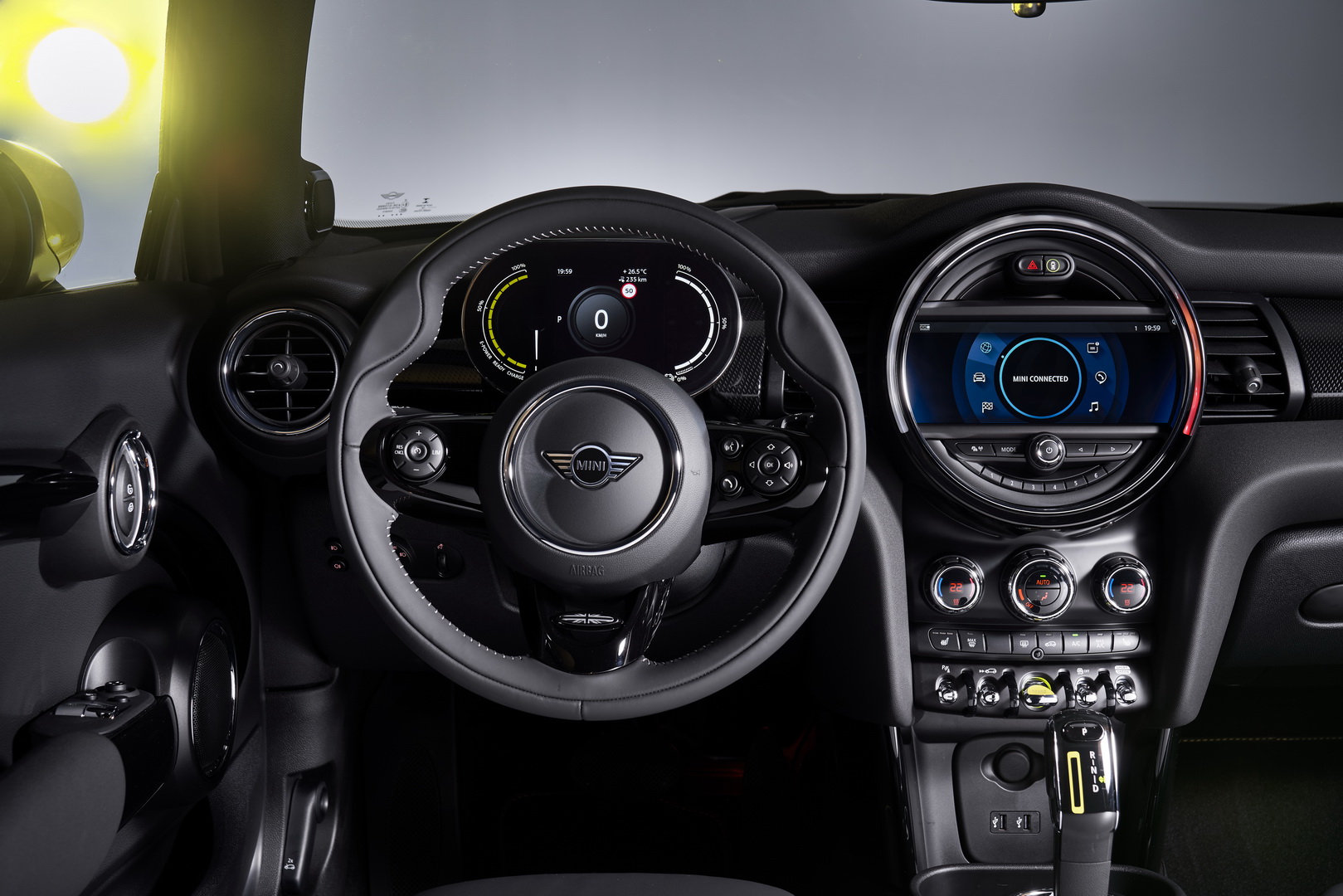
Aside from the different trim and digital gauges, the interior mirrors the design of the regular MINI Hardtop. It’s offered in three levels with the base variant getting 16-inch wheels, LED lights, infotainment system, smartphone connectivity, reversing camera, automatic climate control, heated front seats, and so on. Getting the panoramic roof or leather seats requires upgrading to the top spec.
One pedal driving is possible provided you select the correct setting, and once in motion, users will find the ride to be on the firm side. The steering is sharp and the overall feel is that of a nicely balanced small hatchback. These were highlighted in the video review shared below, which covers other aspects of the car as well, so you may want to check it out to see what the Cooper SE is all about.




 View original content: